
[HGPI Policy Column] (No.72) From the Dementia Project “Rethinking the Concept of Brain Health Through Arts and Culture”
date : 5/19/2026
Tags: Dementia, HGPI Policy Column

![[HGPI Policy Column] (No.72) From the Dementia Project “Rethinking the Concept of Brain Health Through Arts and Culture”](https://hgpi.org/en/wp-content/uploads/sites/2/HGPI_202605_BrainHealthandArts.png)
<POINTS>
- “Brain health” is a multi-faceted concept that includes cognition, emotion, social participation, creativity, and other elements that are related to culture and the arts.
- The arts do not exist outside of medicine; they can be positioned as a foundational element for the display of cognitive functions such as creativity, the formation of meaning, and connectivity with others.
- Artistic activities like music, art, and acting can have multifaceted effects on brain function and well-being by helping people foster creative thinking, regulate emotions, cultivate feelings of self-efficacy, and build social relationships.
- The physical and psychological aspects of health have been the main focus of the conventional medical approach, and not enough attention has been given to areas such as social participation or self-expression. The arts can be positioned as practices that complement the medical approach in such areas and that further expand the scope of support.
- Globally , evidence is accumulating on the relationship between the arts and health or well-being, and efforts to implement that evidence into policy are now advancing. However, concerns toward the formalization of the arts as therapeutic tools or issues regarding the implementation of the arts have been raised. The systematic positioning and best methods of implementing the arts in Japan require further consideration.
Introduction
In the previous installment of this column from the Dementia Project, we examined global discussions and trends in brain health and introduced the underlying concept of brain capital. Rather than indicate the presence or absence of a disease, brain health is being redefined as a state in which individuals can achieve their full potential and contribute to society throughout the life course, and can be regarded as a foundation for societal and economic sustainability. Furthermore, while implementing this concept in the field of dementia will help reduce stigma and encourage people to proactively engage in health activities, implementing it also carries the risk of diluting discussions on diagnosis, treatment, and research for individual diseases. To address this risk, we emphasized the importance of striking a good balance between measures for individual diseases and the comprehensive topic of brain health while advancing discussions for both. For details, please see the link to that column in the related articles below.
Continuing the discussion from our previous installment, this column will focus on the relationship to the arts, which is already an inherent part of the discussion on brain health, as well as on the role that the arts can play in brain health. When people hear the word “art,” most of them probably think of it as something that is separate from healthcare. However, if we take a careful look at the elements that make up brain health, the subject of our previous column, we find that brain health includes items like cognition, emotion, social participation, and creativity, and we begin to see the need to include the arts in our discussions. Instead of viewing healthcare and the arts as two distinct fields, this column will examine them and discuss their latent connection.
Elements from the Arts that Exist within the Context of Brain Health
As mentioned in our previous column, the World Health Organization (WHO) defines brain health as, “The state of brain functioning across cognitive, sensory, social-emotional, behavioral and motor domains.” This means it does not simply refer to the presence or absence of a disease, but instead emphasizes whether or not individuals can activate their full potential throughout the life course.
This definition indicates that brain health is not limited to only being a medical or biological concept. Rather, because it includes social-emotional elements, it also encompasses human relationships, the quality of emotions, and the formation of meaning. In discussions on brain capital (Ayadi et al., 2023), the “cultural environment” has been explicitly identified as a brain capital driver, and access to art and culture has been shown to contribute to brain development and resilience. It is safe to say that art is not an element that was added to discussions on brain health after the fact, but was already something that was woven into its definition and structure. The following section provides an outline of the roles that the arts can fulfill for three elements related to brain health.
- Artistic Elements Related to Creativity and Innovative Thinking
As systematic tasks continue to be automated with AI, creativity and the capacity to solve complex problems are becoming more significant. We are beginning to understand that artistic experiences or activities also have a neuroscientific effect on cognitive function, such as when motor and emotional systems are affected by musical rhythms, or when networks related to attention and memory are activated by visual art. The practice of such artistic activities can function as an experiential environment that cultivates creativity and innovative thinking.
- The Role of the Arts in Regulating Emotions and Forming Meaning
Controlling emotions, handling stress, and maintaining feelings of self-efficacy are also important aspects of brain health. In discussions on brain capital, the locus of control, or the feeling that one is in control of one’s own experience, is considered a key element due to its links to depression and anxiety (Ayadi et al., 2023). Artistic experiences can give form to emotions that are difficult to express in words and can provide people with a means through which they can process their own experiences and assign meaning (Fancourt & Finn, 2019). In addition, the act of artistic creation is deeply connected to feelings of independence, particularly the sense that one has the capacity to create.
- The Potential of the Arts to Support Social Participation and Connectivity
Social conditions are an important dimension of brain capital drivers, and trust, social support, and social cohesion can be viewed as boosters that maintain and reinforce brain health (Ayadi et al., 2023). Collaborative artistic activities such as singing in a choir, performing in theater, or creating community art serve as forms of social participation. In other words, the very act of engaging in artistic activities may have a protective effect on the brain.
The three elements described above form emotions and meaning through cerebral activity in the form of creativity and cognition and, in turn, lead to involvement in society. Areas that are unique to the field of the arts, such as self-expression and cultural participation, can be positioned along that same line. In short, the arts are not something special that exists outside of brain health, but can be interpreted as a natural extension of its components.
How the Arts can Expand the Medical Approach
The healthcare that we have today mainly developed to address aspects of health related to biological function or psychology and emotion. While the framework of providing a diagnosis, prescribing medicine, and providing rehabilitation fulfills a key role in many settings, the conventional medical approach is at times inadequate when handling areas like social participation, creativity, and self-expression.
It is in these areas that the potential of the arts is attracting attention. The arts complement the medical approach and their practice can be viewed as a method of expanding its possibilities. In addition to their positive effect on brain health, the arts are also considered effective for managing chronic diseases, reducing isolation among senior citizens, preventing dementia and encouraging inclusion, and promoting mental health recovery. Implementing the arts in areas that are difficult to address through the conventional healthcare system will make it possible to provide people with support from different perspective.
Developments in the Global Community
Around the world, steady progress is being made in discussions on the role of the arts in healthcare and in efforts to position the arts in policy. A scoping review presented by the WHO Regional Office for Europe in 2019 (Fancourt & Finn, 2019) is widely cited as a systematic overview of evidence for arts-based interventions in prevention, treatment, and management. The practice of healthcare professionals prescribing artistic activities within the framework of social prescribing is becoming more widespread in the U.K. and in Scandinavian countries. However, such initiatives have given rise to concerns that the arts may be medicalized or commodified, as well as unease toward the framework of “prescribing” itself. There are also practical challenges related to human or financial resources. Nevertheless, the international community recognizes the positive impact of the arts on health, and efforts to accumulate research findings and develop policies are underway. Given these trends, we believe more active discussions on the value and role of the arts in the contexts of healthcare or health must also be held in Japan.
In Conclusion
Discussions on brain health are not restricted to maintaining cognitive function or preventing disease, but encompass a broader range of items including emotions, society, and expression. If we carefully retrace its expansion, we find that the arts do not exist outside of medicine, but can be positioned naturally within the continuum that constitutes brain health. Rather than viewing healthcare and the arts as different worlds, we believe that understanding them as parts of the same continuum that supports the minds and bodies of people and their daily lives will become the starting point for future policy and implementation. To examine progress made in the systemic links between healthcare and the arts and to consider the desirable direction for expanding domestic discussions on this topic, our next installment of this column will provide an overview of global discussions on the role of the arts in health and well-being and how the arts have been positioned in systems around the world.
References
-
Ayadi, R., Eyre, H. A., Graham, C., Ronco, S., & Stotts-Lee, E. (2023). The Global Brain Capital Dashboard. Brookings Institution Working Paper. Euro-Mediterranean Economists Association. https://www.brookings.edu/wp-content/uploads/2023/09/20230926_BrainCapitalDashboard_WP.pdf
-
Fancourt, D., & Finn, S. (2019). What is the evidence on the role of the arts in improving health and well-being? A scoping review. WHO Regional Office for Europe. https://www.who.int/europe/publications/i/item/9789289054553
Column author
Nana Moriguchi (Senior Associate, Health and Global Policy Institute)
Related Posts
-
2025-12-01
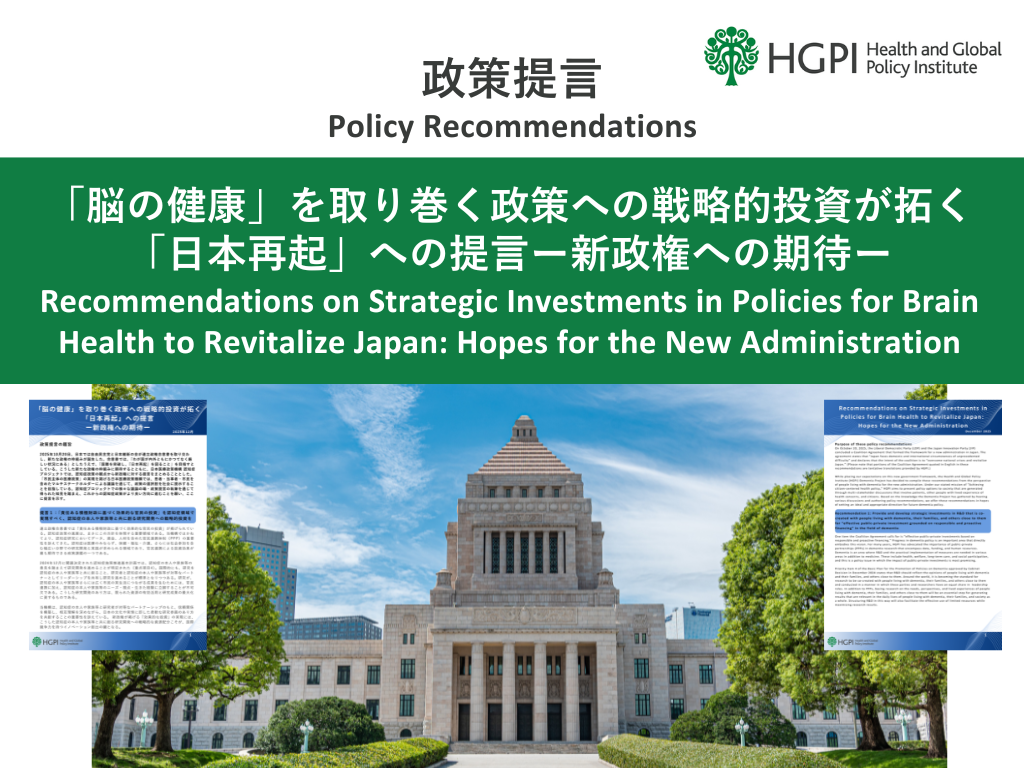
[Policy Recommendations] Recommendations on Strategic Investments in Policies for Brain Health to Revitalize Japan: Hopes for the New Administration (December 1, 2025)
-
2026-03-23
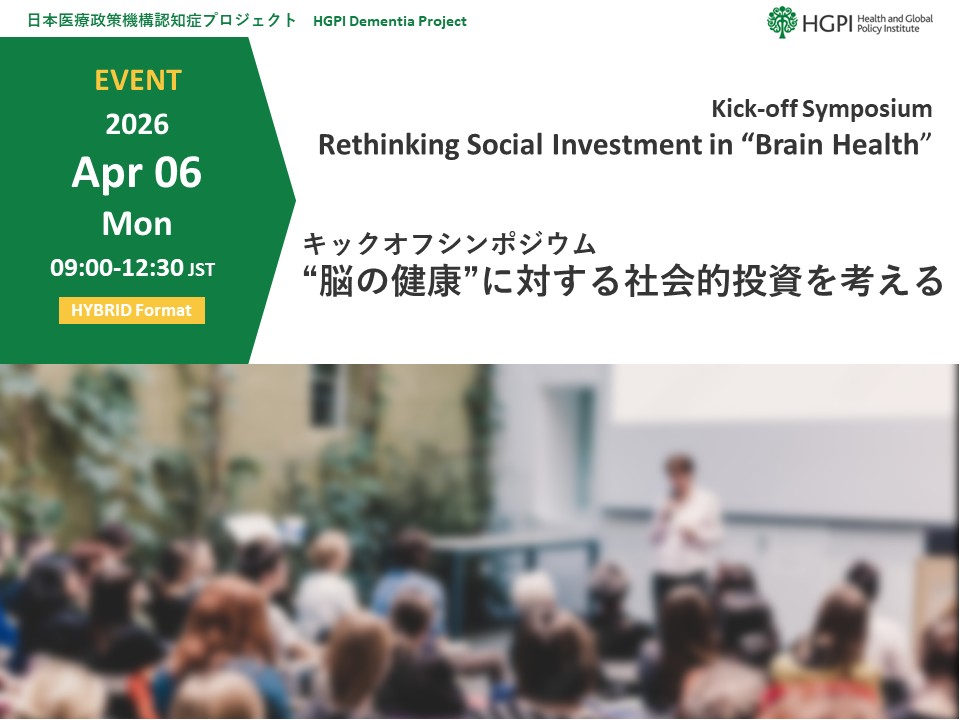
[Registration Closed] (Hybrid Format) Kick-off Symposium: Rethinking Social Investment in “Brain Health” (April 6, 2026)
-
2026-05-15
[HGPI Policy Column] (No.71) From the Dementia Project “Beyond Dementia Measures: Transitioning to a Society That Fosters Brain Health Over the Life Course”
Top Research & Recommendations Posts
- [Research Report] Perceptions, Knowledge, Actions and Perspectives of Healthcare Organizations in Japan in Relation to Climate Change and Health: A Cross-Sectional Study (November 13, 2025)
- [Research Report] Energy Conservation and Greenhouse Gas Emissions Reduction in Healthcare Facilities: Case Studies from New Construction and Facility Renewal (March 16, 2026)
- [Public Comment Submission] “The 7th Science, Technology and Innovation Basic Plan” (Draft) (February 19, 2026)
- [Research Report] The 2026 Public Opinion Survey on Healthcare in Japan (February 13, 2026)
- [Research Report] The 2025 Public Opinion Survey on Healthcare in Japan (March 17, 2025)
- [Policy Recommendations] Dementia Project “The Future of Dementia Policy Surrounding Families and Others Who Care for People with Dementia” (April 27, 2026)
- [Publication Report] Future of the Healthcare System Project “Policy roadmaps for acting early on NCDs” (March, 2026)
- [Policy Recommendations] Mental Health Project: Recommendations on Three Issues in the Area of Mental Health (July 4, 2025)
- [Policy Recommendations] Developing a National Health and Climate Strategy for Japan (June 26, 2024)
- [Research Report] AMR Policy Update #2: WHO’s First Report on Fungal Infection—Bridging the Gap Between Clinical Practice and R&D
Featured Posts
-
2026-05-13
[Registration Open] HGPI Salon 2025-2026 Looking Ahead to the Future of Japan’s Social Security System “Session 5: The Value of Healthcare in Society – Perspectives from the Reiwa Era” (June 29, 2026)
![[Registration Open] HGPI Salon 2025-2026 Looking Ahead to the Future of Japan’s Social Security System “Session 5: The Value of Healthcare in Society – Perspectives from the Reiwa Era” (June 29, 2026)](https://hgpi.org/en/wp-content/uploads/sites/2/5thHGPISalon_20260629.png)
-
2026-05-15
[Registration Open] (Webinar) The 2nd J-PEP Seminar – A New Framework for Providing Information on Clinical Trial Participant Recruitment – Legal Points to Consider from the Perspective of Meaningful Involvement (June 15, 2026)
![[Registration Open] (Webinar) The 2nd J-PEP Seminar – A New Framework for Providing Information on Clinical Trial Participant Recruitment – Legal Points to Consider from the Perspective of Meaningful Involvement (June 15, 2026)](https://hgpi.org/en/wp-content/uploads/sites/2/HGPI_20260615_The2nd-J-PEPseminar.jpg)
-
2026-05-18
[Registration Open] Kick-off Panel Discussion “From Japan and Africa, in Discussion with the World: Cultivating Together a Philosophical Dialogue on Health” (June 15, 2026)
![[Registration Open] Kick-off Panel Discussion “From Japan and Africa, in Discussion with the World: Cultivating Together a Philosophical Dialogue on Health” (June 15, 2026)](https://hgpi.org/en/wp-content/uploads/sites/2/HGPI_hp-20260615-top-1.png)
-
2026-05-19
[Registration Open] (Webinar) HGPI Special Seminar “Building a Society Where People Live with Blood Disorders: The Future of Blood Disorder Policy as Examined from the Frontlines of Home-Based Care × Lived Experience Research” (June 12, 2026)
![[Registration Open] (Webinar) HGPI Special Seminar “Building a Society Where People Live with Blood Disorders: The Future of Blood Disorder Policy as Examined from the Frontlines of Home-Based Care × Lived Experience Research” (June 12, 2026)](https://hgpi.org/en/wp-content/uploads/sites/2/HGPI_20260515_HGPI-Special-Seminar-Blood-Disorders.png)
